
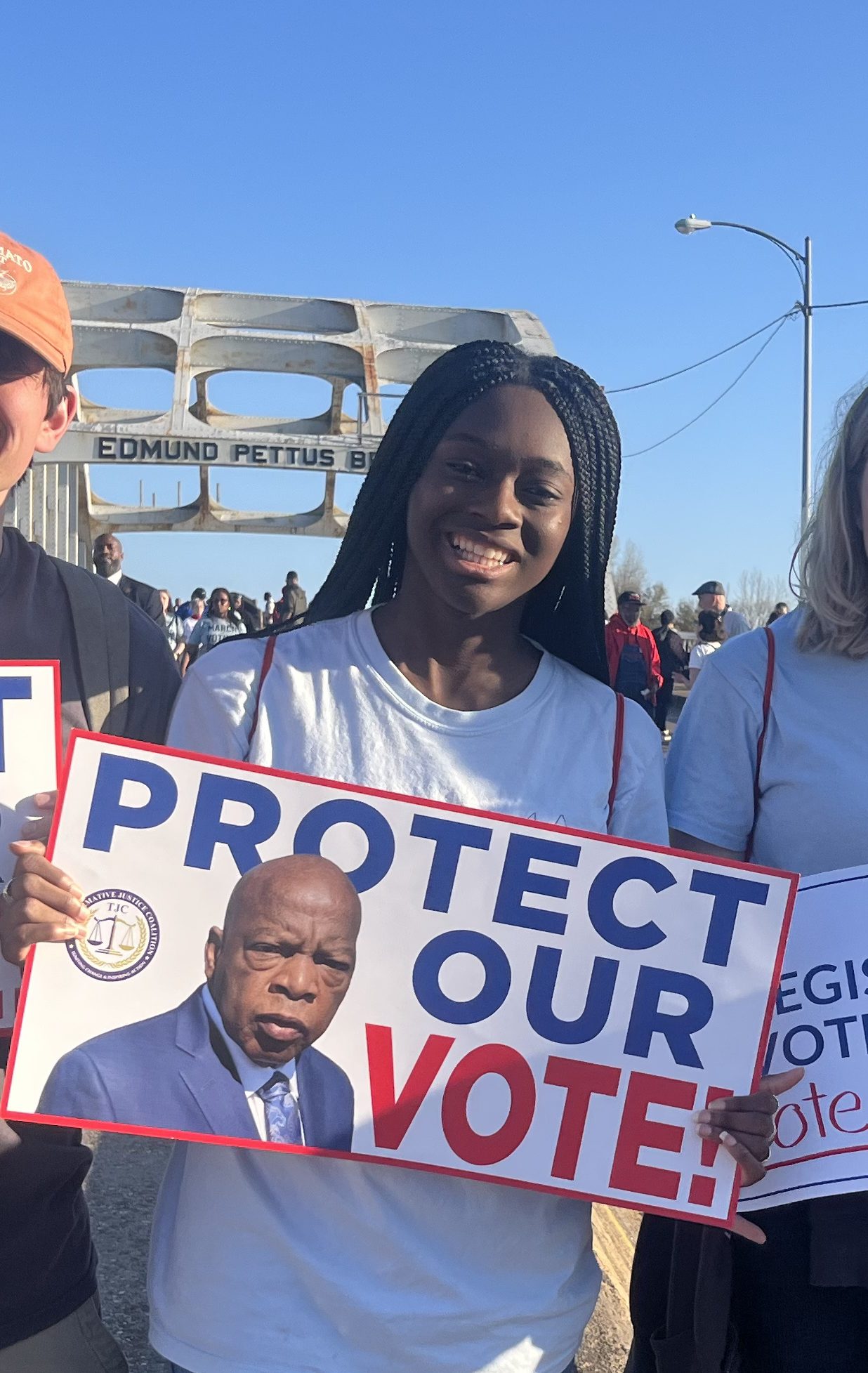
[In March of 2024, RMV had the opportunity to speak to men housed in St. Clair Prison about voting rights and opportunities. RMV intern and UA student Julienne Pharrams writes about her experience visiting the prison below.]
A Reflection on St. Clair
Julienne Pharrams
“They capitalize off of us while we lose our lives”
These words were ringing in my ears as I walked out of St. Clair’s correctional facility. On Friday, March 1st, I entered the walls of the St. Clair’s prison not knowing what to expect but cautiously optimistic that I would learn something that would help me more effectively advocate for the restoration of voting rights for people with felony convictions. What I received instead was an experience that changed me for the better. I received a glimpse into the lives of those that many will never come to know and most will never seek out.
The session began as expected. Dr. Fording began by talking to the men about disqualifying convictions and the Alabama laws that afford convicted and incarcerated individuals an opportunity to vote. Many questions were asked during this session that illuminated specific areas of disenfranchisement laws that are lesser known. For example, one man asked about paying off fines and fees for disqualifying convictions. The men learned, seemingly for the first time, that the money they pay towards their legal financial obligations does not immediately go towards the debt that restricts their voting rights. Instead, it goes towards their oldest conviction unless the individual specifically fills out a request to reprioritize their fees to get their voting rights restored more quickly. This was also the first time many in the room learned they are not eligible for jury duty until they register to vote.
The session continued with an overview of the history of Alabama disenfranchisement laws. It became exceedingly clear that the language used when discussing felony disenfranchisement contributes to a misunderstanding of disenfranchisement in Alabama. There persists a false belief that any conviction leads to a loss of voting rights. Unfortunately, this has prevented thousands of eligible Alabama citizens from ever seeking restoration of their voting rights. Beginning during slavery then transitioning to Jim Crow and most recently to disenfranchisement, the restriction of correct information has been weaponized against the black population and other marginalized communities.
It was during the second half of the visit that I was truly astonished. The session transitioned into a discussion and through multiple conversations, we received pieces of these men’s stories. We asked the men what they were passionate about and what state issues they would like to see explored and addressed. The answers overwhelmingly focused on the younger population in our state. One man started by explaining his passion for changing Alabama’s juvenile laws. Amongst more discussion, he shared that he was in prison for a crime he was convicted of at 16. He is now 48 years old. Another man was passionate about educating the youth, particularly in urban neighborhoods. He wants to make sure they know options exist beyond a life of crime. He wants to see them empowered to succeed in life. Yet another man expressed his desire to see minors convicted of capital crimes receive an opportunity to prove that they have been rehabilitated upon reaching adulthood. Throughout this conversation, the men were passionate and articulated their concerns in a way that was both effective and moving. During the conversation about brain development, findings from adolescent experts were shared. Amidst expressed discontentment with Alabama laws, quotes from the Alabama constitution and sections of the State’s penal code were thrown out.
As I sat and listened during this conversation, I witnessed the demolition of countless stereotypes. Stereotypes about prisoners are widely perpetuated, often without thought. There exists an unfortunately prevalent idea that to commit a crime is to forfeit your humanity. Many paint prisoners as uneducated, unsafe, and apathetic. However, these men took the time allotted to them as a chance to advocate for themselves and instead focused largely on speaking for children in difficult situations.
What is often lost during all of the discussion about punishment vs rehabilitation and even disenfranchisement is the humanity of prisoners. They are people. They are human beings with lives and families and dreams and a favorite song. They are human beings whose lives did not end when they were incarcerated. They are human beings with voices and a right to use them. It is beyond time we listened. It is beyond time we cared.
